Who decided first?
In many workplaces, AI now enters before a person has made an initial call. A draft appears first. A recommendation appears first. A summary appears first. Then a human reviews what is already on the page and still carries the accountability for the final answer.
That sequence matters because the first framing can narrow what gets noticed. Ethan Mollick wrote that experts working with AI agents are swayed by the positions of the AI even when they think they are working independently, as he noted in a public post. The point is not that human judgment disappears. The point is that it can be bent early, before the reviewer experiences that bend as influence.
This is a present-tense workplace problem, not a distant one. Teams use AI to prepare briefs, rank options, summarize cases, draft analyses, and propose next steps. In proportion, that often helps with speed and coverage. But where a task still depends on a genuinely independent check, an early model output can quietly take authorship of the frame. The person may still decide the final line, while the system has already shaped the field of attention.
That is the loss worth naming clearly. If nobody protects the independence of the first pass, the review seat remains human in title while the opening judgment has already been narrowed by the machine's position. Accountability stays with the person. Some of the authorship of the decision path does not.
The mistake is often framed as overreliance, as if the only question were whether AI is used at all. The narrower and more useful question is sequence. A person can intend to review carefully and still inherit the model's starting point if the model arrived first.
That is why this issue belongs to workflow design. The order of steps decides whether the human review is a genuine first look or a reaction to a machine proposal that has already set the terms.
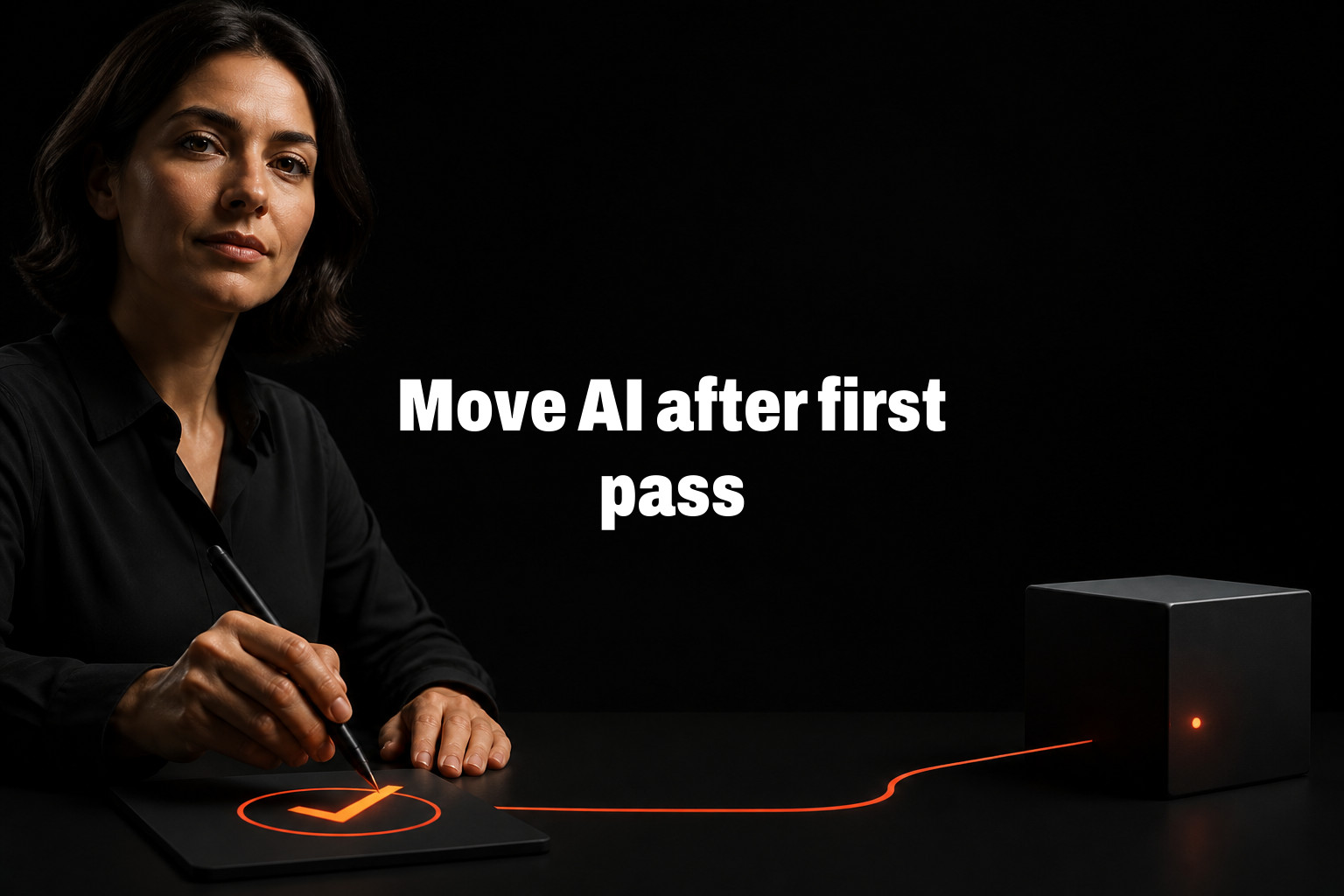
Move AI after the first pass
The practical control is not to ban AI. It is to place it later when independence matters. Mollick's same post makes that process point directly: if independent judgment matters on a task, people need to be deliberate about when in the process they use AI, as he wrote in the same source.
That leads to a simple rule for work this week. If a task needs real human review, do the first pass before seeing the AI. Read the file first. Mark the risks first. Write the initial explanation first. Commit to a tentative view in notes before opening the model's draft or recommendation. Then bring AI in as a second input: to compare, challenge, expand, or test the work you have already framed.
What this changes in practice
- In hiring, write your first candidate assessment before reading the model summary.
- In analysis, outline your conclusion before checking the AI draft.
- In quality review, mark issues before opening the automated recommendation.
- In writing, decide the argument before asking the model for revisions.
The mechanism is simple reasoning. Early exposure sets a reference point. Later exposure becomes something you can evaluate against your own first judgment. That does not make the human infallible. It preserves a real comparison between two positions rather than one position and a review shaped by it.
There is also a useful boundary here. Sam Altman said people should not take important life advice from ChatGPT, as shown in a public video post. The workplace version is narrower and more practical: where the human check is supposed to remain independent, the timing of AI use is itself part of the decision design.
One takeaway for this week
Choose one recurring task where your name stays on the final answer. Change only the order. Make your first pass without the model, leave a brief record of your initial view, then compare it with the AI output after. If independence matters, that sequence protects it better than a promise to "think for yourself" after the draft is already in front of you.
Human Runtime Core™ is designed for the mental edge you need to survive in an AI-run world.