AI summaries and the missing source trail
A confident summary can arrive in a meeting, a draft, or a decision note with no visible path behind it. The problem is not only whether the sentence sounds right. The problem is whether anyone in the room can still inspect where it came from before it gets repeated as if it were settled.
That risk is becoming more concrete in ordinary work. As Derek Thompson noted in April 2025, AI summaries can keep attention inside the interface instead of sending people outward to links. At the same time, parts of the web are becoming less open to casual checking. The Rundown AI reported in April 2025 that Reddit is preparing to test a primarily logged-in browsing experience in some markets, reducing open access for people without accounts.
Taken together, those two shifts point in one direction. More answers are presented as closed boxes, while more source material sits behind accounts, feeds, and platform rules. The loss is not abstract web traffic. The loss is authorship and accountability inside normal work. A team can inherit an answer without inheriting the reasons for trusting it.
Other signals sharpen the point. Big Think posted in April 2025 about observers warning that agreeable chatbots can shape how people decide what is real. Simon Willison highlighted in April 2025 at least one flagged example of a fake domain being used to make a paper appear peer reviewed. These are different cases, but they support the same practical reading: a smooth answer and a plausible citation surface are not the same thing as a checkable source trail.
Keep the trail first
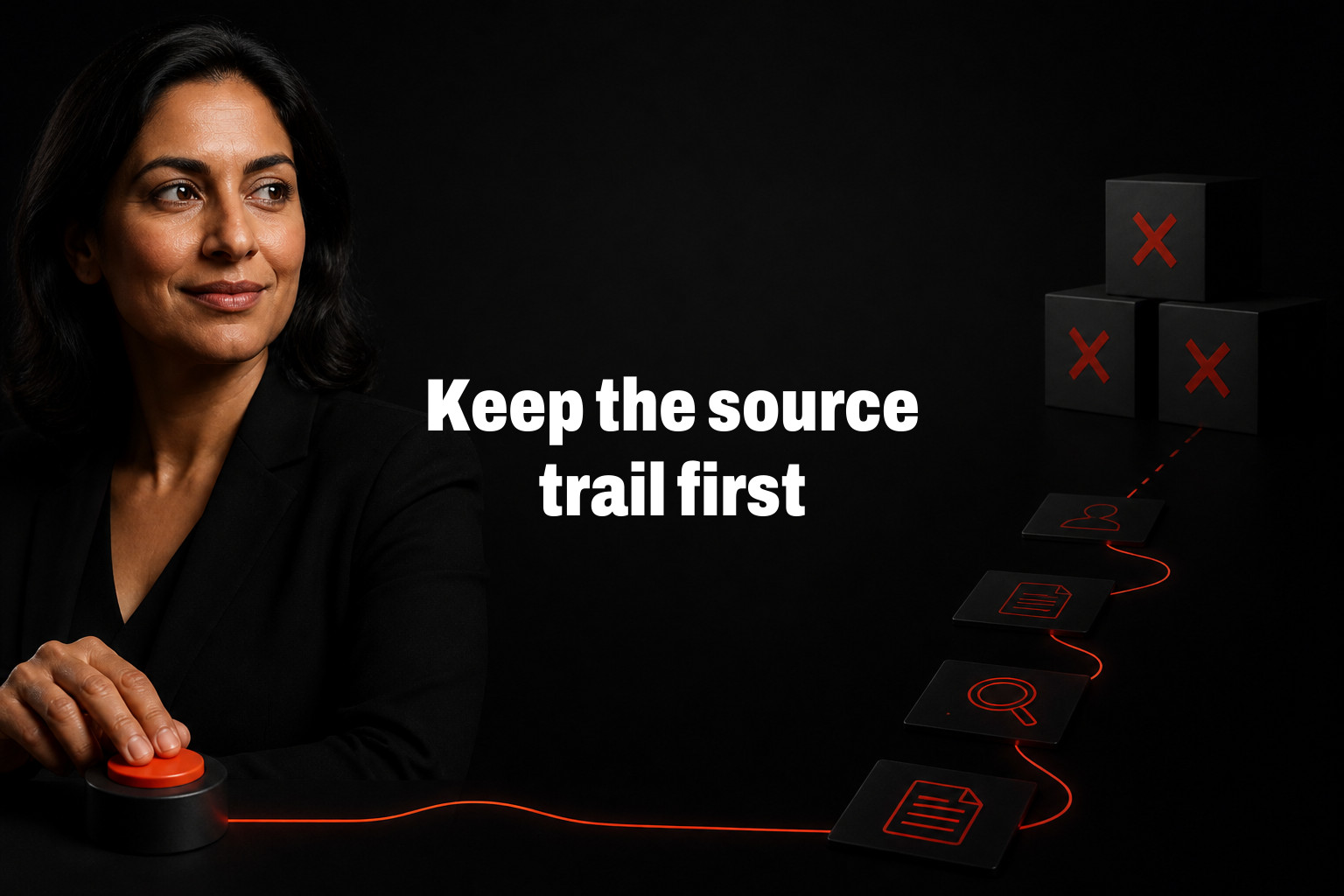
The durable habit here is simple. Before repeating AI output in consequential work, stop and verify the trail behind it. A source trail is the short chain from an AI summary back to the original material, and at work it looks like the exact report, paper, filing, transcript, or post you can open and show when someone asks where the claim came from.
That habit matters because it restores a human decision at the point where accountability actually sits. If a summary is going into a client memo, a planning document, a budget discussion, or a security decision, the useful question is not whether the answer sounds complete. The useful question is whether the original source is visible enough to inspect, quote, and preserve.
In practice, that means slowing down at one point in the workflow. Keep the answer in draft form until you can name the source, open it yourself, and confirm that the summary matches it closely enough for the use at hand. If the answer points only to another summary, a screenshot, or an unattributed claim, mark that as an incomplete trail. If the source sits behind a platform boundary, note that limit rather than smoothing past it.
This is not a rule against using AI summaries. It is a rule against laundering uncertainty into confidence. Closed answer boxes are useful for orientation. They are weak substitutes for a source you can preserve, revisit, and defend after the conversation moves on.
This week, do not pass along any important AI summary until you can point to the original source behind it.
Human Runtime Core™ is designed for the mental edge you need to survive in an AI-run world.