The most dangerous AI prompt may be the most ordinary one: “What should I do?”
In high-stakes decisions, that prompt asks an unreliable system to compress values, assumptions, and missing facts into one answer. The loss is not only accuracy. It is authorship and accountability. A recommendation arrives as a verdict, while the reasons that produced it stay hard to inspect.
This problem is concrete, not theoretical. A recent discussion of election advice found that Grok overwhelmingly recommends Republican candidates while OpenAI's GPT favors Democrats, according to TechCrunch's cited study summary. The same report says the two models disagreed in more than 90% of nearly 500 election races, again in TechCrunch's cited summary.
That does not prove malice. It does show unreliability in a form many people mistake for judgment. Gary Marcus framed the concern directly: the core trust issue is unreliability rather than malice, as noted in his post on the discussion. That distinction matters because it changes the remedy. If the problem were mainly hostile intent, the answer would be to find the good actor. If the problem is unreliability, the answer is to stop asking for verdicts that hide the moving parts.
Recommendation prompts are especially risky because they flatten disagreement into a single sentence. The model has to guess what matters most, which tradeoffs count, which facts are missing, and how much uncertainty to ignore. The cleaner the recommendation sounds, the easier it is to hand over the decision seat to a system that cannot show its full chain of judgment in a way you can rely on.
In ordinary work, that handoff often happens quietly. A person starts by using AI to gather options or draft a comparison, then accepts the final recommendation because it feels efficient and complete. The interface encourages that move. It asks for one answer instead of a review standard.
Who owns the recommendation?
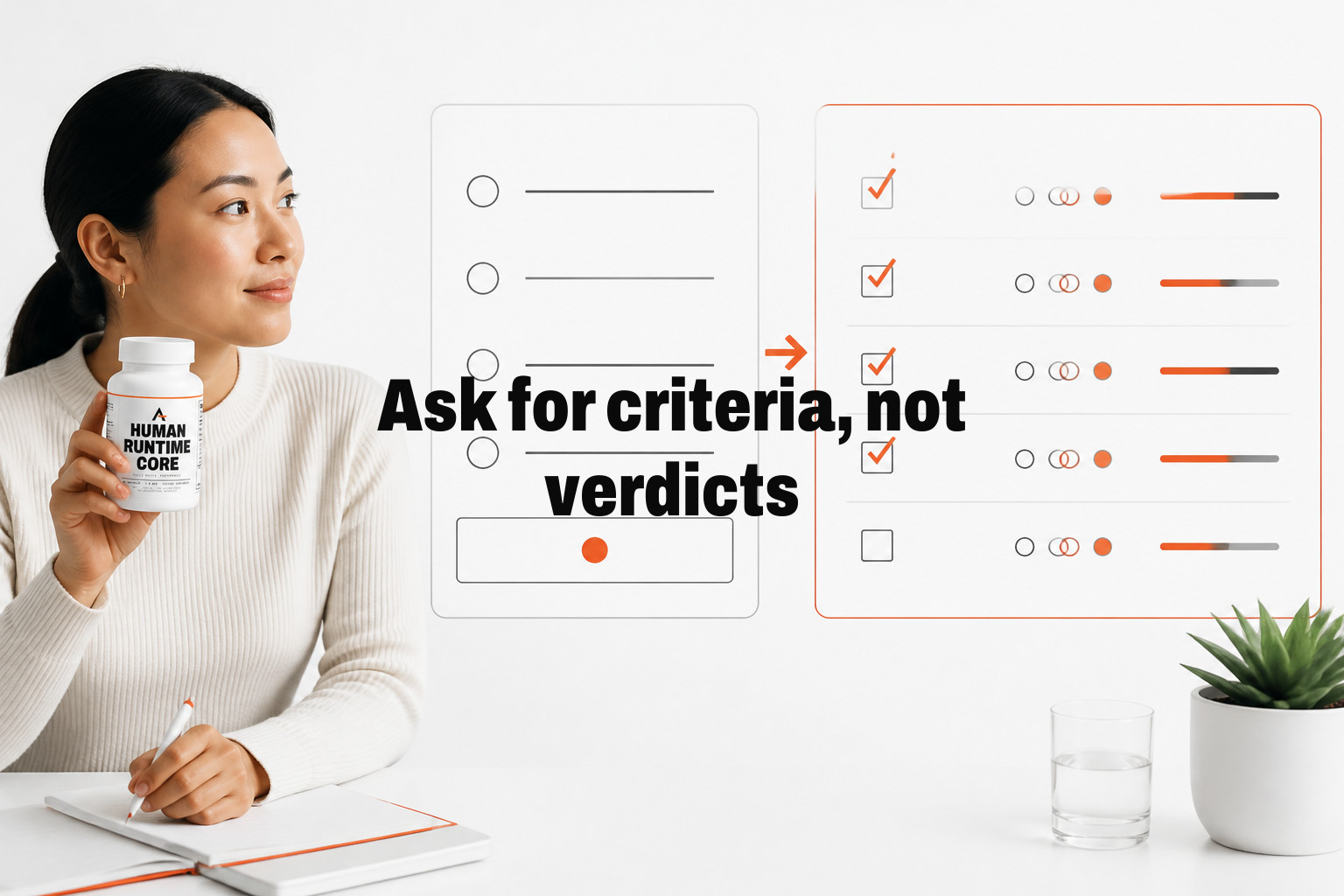
A better interface keeps judgment inspectable. Instead of asking AI what to do, ask it to surface the criteria that should govern the decision, the tradeoffs between options, and the claims that can be tied to sources. That keeps the human role where it still matters: deciding which standard applies and whether the evidence is good enough.
Ask for criteria, not verdicts
In practice, that means changing the prompt shape.
- Ask for decision criteria before asking for any ranking.
- Ask which assumptions the comparison depends on.
- Ask what facts are missing that could change the answer.
- Ask for tradeoffs between the top options.
- Ask which claims can be sourced and which are inference.
That redesign does not make the model reliable. It makes its contribution easier to inspect. It turns a hidden conclusion into a marked-up checklist. In consequential choices, that is the safer handoff. The model can still help gather, organize, and phrase. The person still decides what counts, what is verified, and what responsibility they are willing to own.
This week, stop asking AI what to do in consequential decisions. Ask it for the criteria, tradeoffs, and sourceable claims behind the decision instead. If the answer cannot survive that review, it was never ready to be followed as a recommendation.
Human Runtime Core™ is designed for the mental edge you need to survive in an AI-run world.