Who still holds the seat?
In large firms, one near-term AI change is easier to picture than a full redesign of work: senior management can watch more of the company, more directly, through AI systems connected to company data. Ethan Mollick described this as an expansion in the role and span of control of senior management, with the possibility that leaders can monitor much more of the firm from the top in his discussion of AI and management. That is not the same as a reinvention of the company. It is a change in who can see, summarize, and press for action first.
That matters because monitoring changes operations even before job descriptions change. The same discussion argues that top-level visibility can significantly reshape how a company runs in the same thread. When more workstreams collapse upward into one screen, the seat that matters is not only the person doing the task. It is also the person deciding what counts, what gets escalated, and what is treated as complete.
The institutional point is simpler than the technical one. Reorganizing a firm is slow, political, and hard to finish. It means changing incentives, handoffs, approvals, and ownership across teams. By contrast, top-down monitoring is described as straightforward to implement compared with firm redesign in Mollick's note on the contrast. If a company can add dashboards, summaries, and cross-functional visibility without first rewriting the org chart, that is usually the path it takes.
A second fact sharpens the horizon. Current frontier models are described as capable of this kind of company-specific work when connected to a firm's data, without much specialized work in a follow-up post on model capability. The inference is not that every company will suddenly become machine-run. It is that the first practical use inside many firms is likely to be centralized oversight, because it asks less of the institution than redesigning the institution.
The loss, if nobody decides otherwise, is not merely privacy or autonomy in the abstract. It is authorship over key judgments. A summary becomes a direction. A risk flag becomes a priority. A metric becomes the work. Once that translation is happening upward and at scale, managers do not need to redesign the firm to change how the firm behaves. They only need a system that makes more of it legible from the top.
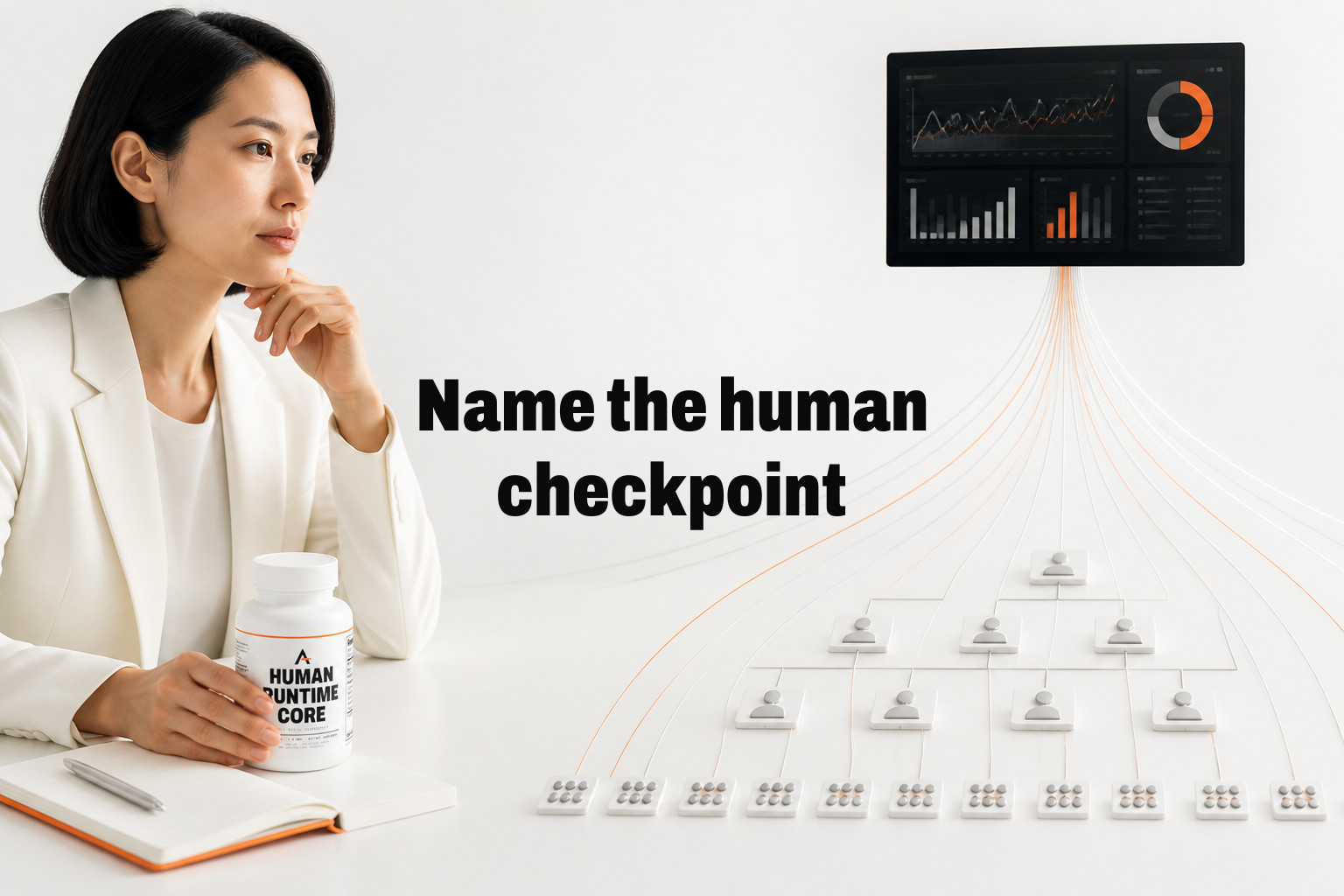
Name the human checkpoint
That still leaves a live seat for a prepared person to hold. The useful move is not to argue with visibility. It is to specify where visibility stops and judgment begins. If dashboards and AI summaries are becoming the easier layer to add, then the important counterweight is a named human checkpoint at the moments where interpretation changes consequences.
A checkpoint is concrete. It is the approval before a customer policy changes, the review before a performance label becomes part of a file, the signoff before an exception is denied, the decision on whether a model summary is enough to escalate a team. These are not objections to AI. They are boundaries around who is accountable for translating a system's description into direction.
This is also a better near-term discipline than waiting for a grand redesign. Most firms will not begin by rebuilding themselves around distributed AI judgment. They are more likely to centralize first because it is easier to do. That means the people who want to preserve responsible decision-making should work at the level of checkpoints, not slogans. Write down where a named person must review, decide, or verify before an AI-mediated overview becomes an instruction.
This week
Decide what work needs a named human judgment and write that checkpoint down before dashboards and summaries turn oversight into direction.
Human Runtime Core™ is designed for the mental edge you need to survive in an AI-run world.